Beacon Hills Cyclones
Holding Out for a Hero ▸ Stiles Stilinski (2)The Beacon Hills Cyclones are the school lacrosse team at Beacon Hills High School, a student organization that anchors several of the story's most important contrasts: ordinary athletic competition against supernatural violence, team discipline against personal secrecy, and the public rituals of school life against the danger spreading through Beacon Hills. The Cyclones are not merely background decoration. Their games repeatedly place Scott McCall, Stiles Stilinski, and Carson Bradley in situations where the rules of sport are forced to coexist with the rules of the supernatural.
Identity and Place in School Life
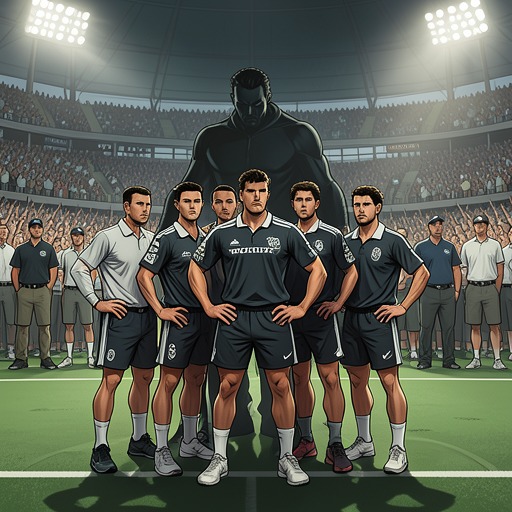
The Cyclones function as one of the main visible institutions of Beacon Hills High School. Their players assemble under Coach Finstock's authority, wear uniforms, occupy a defined field and bench, and are expected to perform within the ordinary limits of a school team. That normality matters because Scott's involvement gives him a continuing connection to a life that existed before the supernatural crisis intensified. The team is therefore both a social setting and a measure of what the characters are trying to preserve.
The team's culture is shaped by Coach Finstock's abrasive humor and theatrical impatience. During the winter semifinal, he mocks the opposing team's enormous player, Eddy Abomowitz, calling him an “Abomination” and demanding to see a birth certificate. The joke converts a frightening physical mismatch into sports-bench banter, but it also establishes the game's central tension: the players are confronting something that seems too powerful to belong within the ordinary category of teenage competition.
The Semifinal Crisis
The Cyclones are decisively losing their semifinal to the Beavers, and the opposing number 42 appears so large that Carson Bradley compares him to an ogre. Players are repeatedly slammed to the ground, leaving many of the Cyclones with possible concussions. After seven minutes of emergency substitutions, Coach Finstock has to return injured players whose conditions can merely be overlooked, while Jackson Whittemore and Scott McCall remain unavailable. The team is left short of players and unable to function as a normal competitive unit.
The shortage leads Coach Finstock to call for Stiles Stilinski, but Stiles is absent. In an unexpected reversal, Boyd is recruited from the sidelines. He removes his jacket and steps onto the field, and Finstock celebrates the discovery of another player. Boyd's emergency participation briefly restores the team's numbers, yet the scene also exposes the fragility of the Cyclones' ordinary structure: a supernatural crisis has already displaced key players, injured others, and turned a regulated game into an improvised survival situation.
The game becomes even more dangerous when the giant lizard creature appears inside the sports facility. Carson Bradley and Stiles Stilinski see it climbing the metal fencing around the indoor balcony before it drops to the floor and shifts onto all fours. Derek Hale confronts it with a roar, but the creature's tail strikes Erica Reyes and knocks her unconscious. Derek then forces Stiles Stilinski and Carson Bradley to retreat. The Cyclones' athletic setting is thus invaded by the Kanima, and the boundaries separating school sport from supernatural violence collapse completely.
Team Membership and Supernatural Conflict
The Cyclones' roster is connected to the wider supernatural network through its students. Scott McCall's position on the team makes his academic performance a practical threat to his future participation. Coach Finstock tells Scott that he cannot put him on the field next season unless Scott raises his grades, then admits that despite his constant yelling, he does not actually hate the players and needs Scott on the team. The exchange gives the team an unexpectedly personal dimension: continued membership depends not only on athletic ability but also on Scott's capacity to maintain the ordinary responsibilities of a student.
Other team-linked students are drawn into the crisis in different ways. Jackson Whittemore is central to the Kanima mystery, while Boyd's sudden recruitment shows how the team can absorb a player from outside the immediate lineup when necessity demands it. Stiles Stilinski is associated with the team even when he is missing from the field, and Carson Bradley watches both the match and the danger surrounding it from the bench. The Cyclones therefore operate as a network of friendships, absences, injuries, and obligations rather than as a purely athletic unit.
Normality Under Pressure
The team's games repeatedly dramatize the cost of trying to maintain normality in Beacon Hills. A lacrosse match has recognizable rules, positions, substitutions, uniforms, and spectators, but those structures cannot contain a creature that paralyzes victims with venom, fears water, and appears as an overgrown reptile. The characters move between the language of sport and the language of supernatural investigation: they discuss lineups and concussions, then search the Internet and the bestiary for information about the Kanima.
This collision also shapes the story's distinctive game-like rhythm. The characters investigate the creature through scattered clues, test its weaknesses, seek equipment from Deaton at the Beacon Hills veterinary office, and repeatedly return to physical spaces associated with school life. The Cyclones' field is not a safe opposite to the supernatural world; it is one of the places where that world becomes visible. Athletic teamwork, emergency improvisation, and supernatural alliance begin to resemble parallel forms of coordinated action.
Narrative Significance
The Beacon Hills Cyclones give the narrative a public stage on which private danger cannot remain private. A player being injured can initially be treated as part of a rough game, but the scale of the injuries and the creature's arrival reveal that the apparent sports narrative is masking a larger emergency. The team's defeat by the Beavers intensifies the humiliation and pressure, while the Kanima's appearance transforms that sporting failure into a life-threatening confrontation.
At the same time, the Cyclones preserve the possibility of a future beyond crisis. Coach Finstock's insistence that Scott improve his grades assumes that next season still matters. His claim that the team needs Scott, however awkwardly expressed, makes participation a form of belonging rather than a simple athletic requirement. The Cyclones consequently represent both the normal life the characters are losing and the ordinary community they continue trying to defend.